Voice response latency
~1-1.25s
Near real-time performance for natural phone interactions.
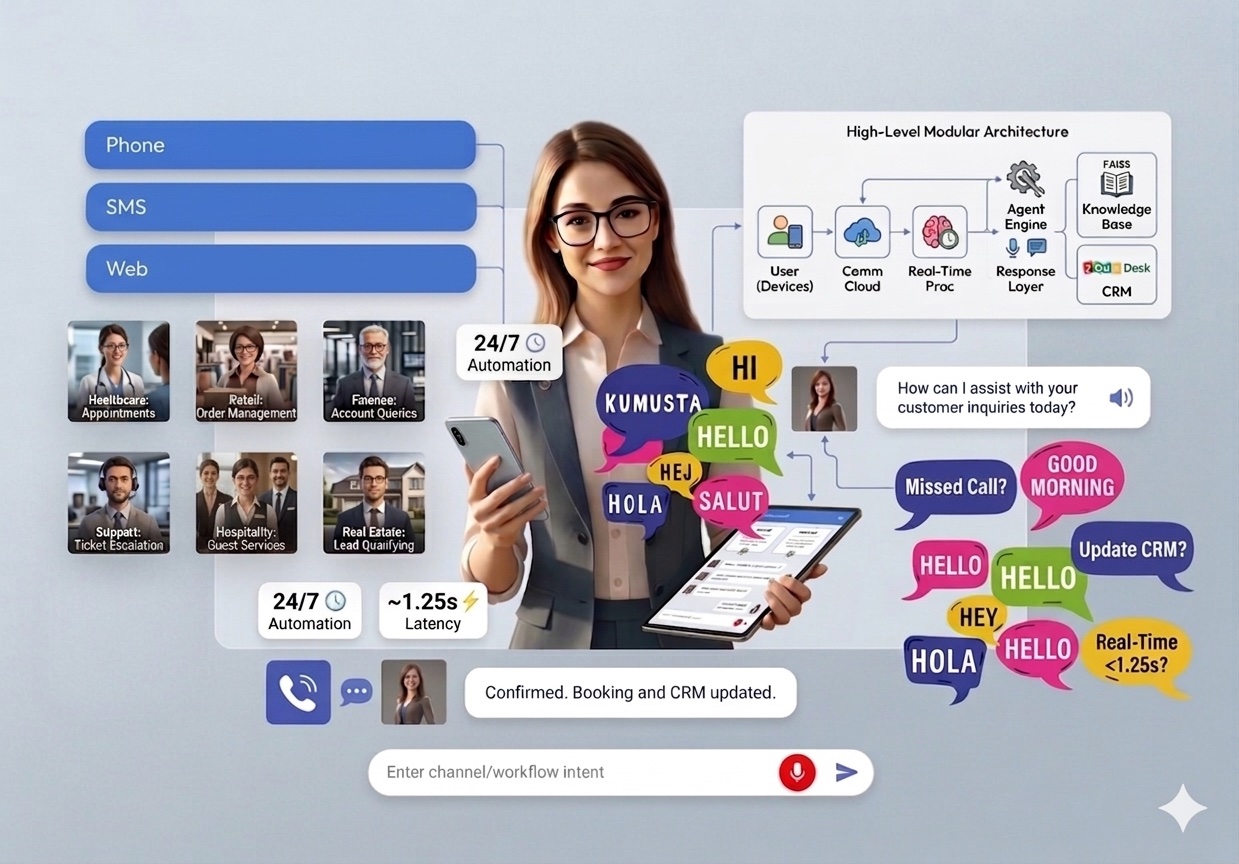
AI Workforce SaaS is a production-grade platform that enables businesses to launch AI assistants across phone, SMS, and web chat, combining real-time conversational AI with workflow automation, business knowledge retrieval, and CRM-connected actions.
Businesses needed more than a chatbot. They needed an AI system that could handle real customer interactions across channels, keep latency low enough for voice, and execute business workflows reliably in production.
The platform was designed as a modular AI agent system: communication channels fed into a shared orchestration layer, which combined prompts, retrieval, workflow execution, and response generation to produce fast, grounded, action-oriented outcomes.
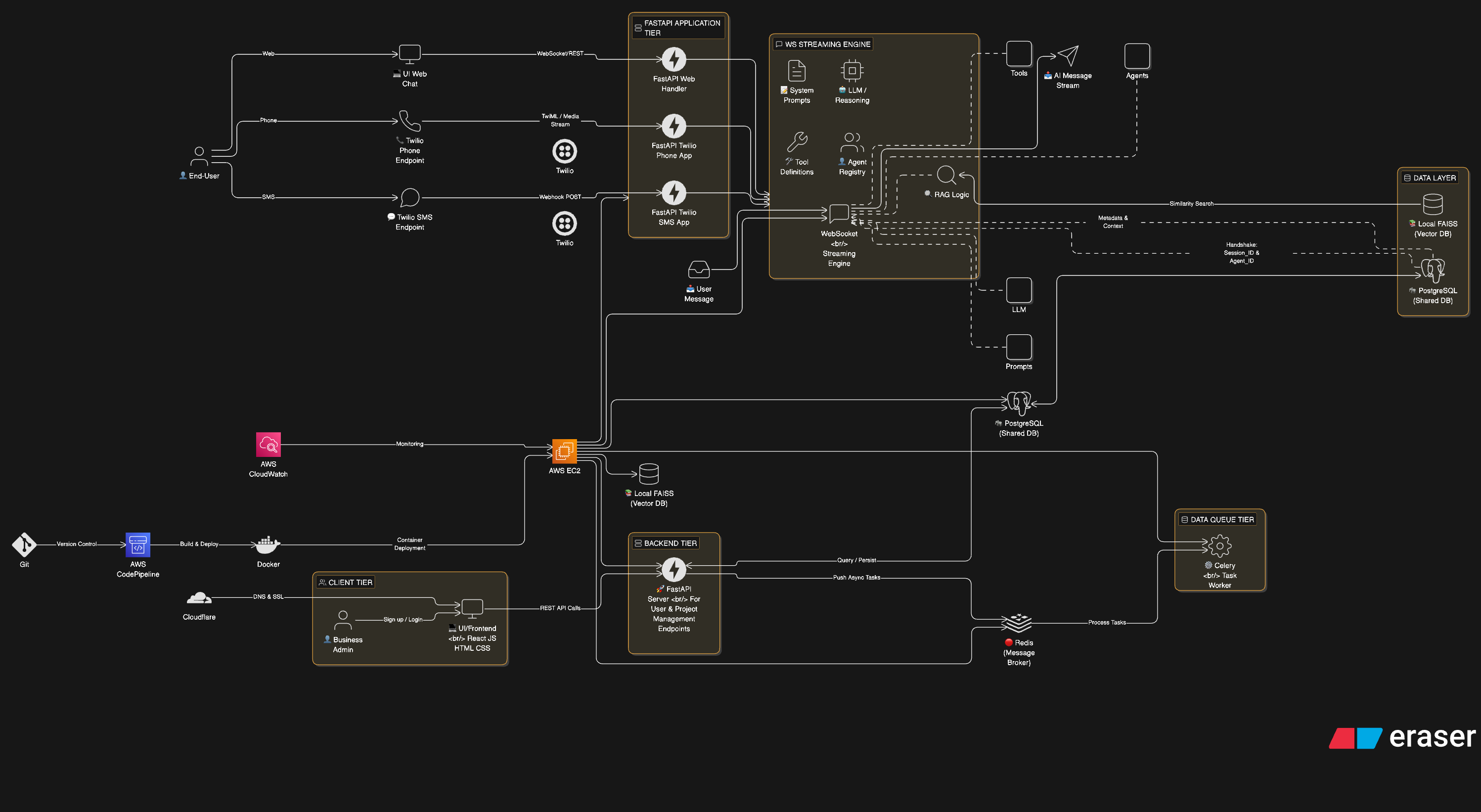
The platform delivered more than AI conversations. It created a unified business automation layer that could answer questions, retrieve context, trigger workflows, and update external systems.
Streaming STT, LLM token generation, and TTS orchestration for natural voice and text interactions.
Website scraping, document parsing, chunking, embedding, and retrieval using a FAISS-backed vector store.
Intent-driven actions for appointment booking, routing, ticketing, order handling, and CRM updates.
A shared context layer allowed the same business agent to operate across phone, SMS, and web chat.
Vertical-specific prompting and knowledge setup for healthcare, retail, finance, hospitality, and real estate.
Conversation logs, latency tracking, escalation signals, and feedback loops for continuous quality improvement.
Challenge: Traditional voice assistants often feel delayed and robotic, which makes conversations awkward and reduces trust.
Approach: The system streamed speech-to-text partials, generated incremental LLM responses, and coordinated text-to-speech output in parallel with optimized buffering.
Result: The platform achieved roughly 1-1.5 second response times, enabling natural, interruptible, human-like phone conversations.
Different channels create different UX constraints, but businesses need consistent behavior. A shared agent core was built beneath the communication layer so channel-specific inputs could map into the same memory, orchestration, and action systems.
This let the same assistant handle calls, messages, and chat sessions without rebuilding business logic for each channel.
The onboarding flow allowed businesses to submit websites, documents, FAQs, SOPs, menus, and other internal content. That data was scraped or parsed, chunked, embedded, and stored in a self-hosted vector layer for semantic retrieval at runtime.
Combined with CRM context from Zoho Desk, the assistant could answer with current, business-specific information and significantly reduce hallucination risk.
The runtime followed an event-driven pattern: Trigger -> Intent -> Action -> Response. This enabled appointment booking, order processing, call routing, ticket creation, and CRM updates.
Integrations with scheduling systems, databases, and business APIs turned the assistant into an operational interface rather than a passive chat surface.
Generic prompts were not enough for production. The solution used vertical-specific prompting and business context for healthcare, retail, finance, hospitality, and real estate use cases.
This improved relevance, increased task completion, and produced more dependable outputs in real customer workflows.
The platform logged conversations, failure states, escalation patterns, and latency metrics to support monitoring and iteration. Dashboards and feedback loops made it possible to refine prompts, workflows, and business logic over time as usage expanded.
The strongest value came from combining speed, automation depth, and cross-channel consistency into one product that businesses could adapt to their own operational workflows.
This project involved end-to-end ownership across architecture, AI systems, backend engineering, integrations, and production reliability.
The project reinforced a practical principle: successful AI SaaS products win when they balance model quality with response speed, workflow completion, and operational reliability.
In voice systems, latency is not a backend metric. It directly shapes user trust and adoption.
Vertical-specific prompts and retrieval delivered much stronger outcomes than a one-size-fits-all assistant.
The highest-value experiences came from triggering real actions, not simply returning well-worded answers.